
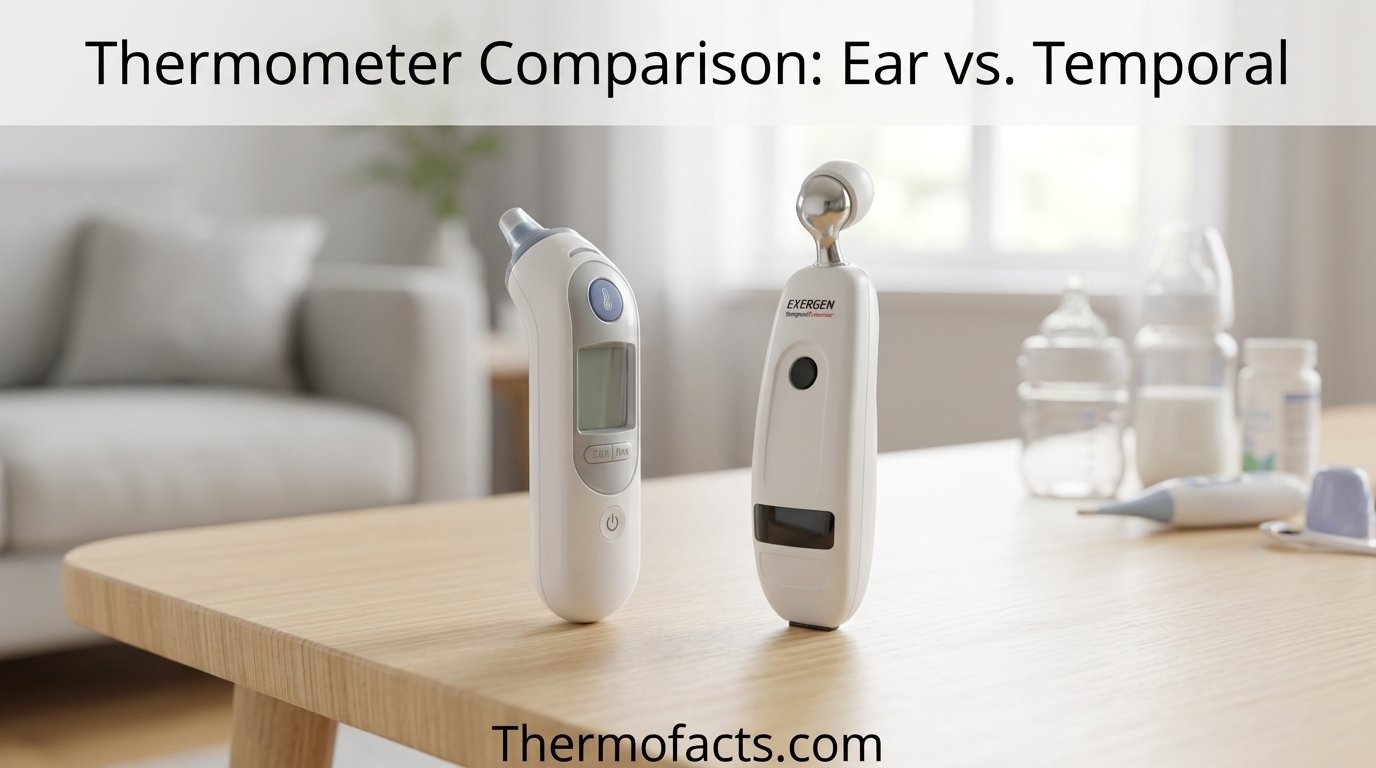
Ear Thermometer vs Temporal Thermometer: Which One Actually Belongs in Your Medicine Cabinet?
A no-nonsense, evidence-based comparison covering accuracy, speed, hygiene, cost, and which device fits your family best.
Introduction
Standing in the pharmacy aisle staring at a wall of thermometers is one of those small parenting or caregiving moments that feels bigger than it should. Digital oral thermometers, forehead strips, ear thermometers, temporal artery scanners — every box promises “fast, accurate results,” and none of them explain why the same fever might read differently depending on which device you grab. If you’ve narrowed your choice down to two of the most popular non-invasive options — the ear (tympanic) thermometer and the temporal artery (forehead) thermometer — you’re already ahead of most shoppers. Both are quick, both avoid the discomfort of oral or rectal readings, and both have loyal followings among parents, nurses, and caregivers.
But “both are good” isn’t a real answer when you’re standing over a feverish toddler at 2 a.m. and need a number you can trust. This guide breaks down exactly how each device works, where each one shines, where each one quietly fails, and which situations call for one over the other. We’ll also look at cost, hygiene, calibration, and the mistakes that quietly ruin accuracy for both types of thermometers. If you want a deeper primer on digital thermometers in general before diving into this comparison, our guide on what a digital thermometer actually is is a useful starting point.
By the end of this article, you won’t just know the textbook differences between ear and temporal thermometers — you’ll know which one deserves a permanent spot in your medicine cabinet, and why keeping both on hand is sometimes the smartest move of all.
What Is an Ear (Tympanic) Thermometer?
An ear thermometer, also called a tympanic thermometer, measures body temperature by reading the infrared heat radiating from the eardrum and surrounding ear canal tissue. Because the eardrum shares a blood supply with the hypothalamus — the part of the brain that regulates body temperature — readings from this area are considered a fairly close proxy for core body temperature, provided the device is used correctly.
Physically, an ear thermometer looks like a small handheld gun with a probe tip that you insert gently into the ear canal. Most models use disposable plastic probe covers to keep the sensor lens clean between users, which matters a lot in multi-person households or clinical settings. Within one to three seconds of a proper seal, the thermometer calculates and displays a temperature reading, often with a soft beep to confirm the measurement was captured.
Ear thermometers became especially popular in pediatric care throughout the past few decades because they offer a faster, less invasive alternative to rectal thermometers for infants and toddlers, while still tapping into a body region close to core temperature. That said, ear thermometers are notoriously sensitive to technique — a common source of frustration is discussed later in the common mistakes section.

See Top-Rated Ear Thermometers
Browse current bestselling tympanic thermometers with fast one-second readings.
Check Price on AmazonWhat Is a Temporal Artery Thermometer?
A temporal artery thermometer, often just called a “forehead thermometer,” measures the infrared heat emitted by the temporal artery — a blood vessel that runs just under the skin across the forehead. Because this artery carries blood almost directly from the heart, it offers a reasonably fast and stable read on core temperature without ever touching a mucous membrane.
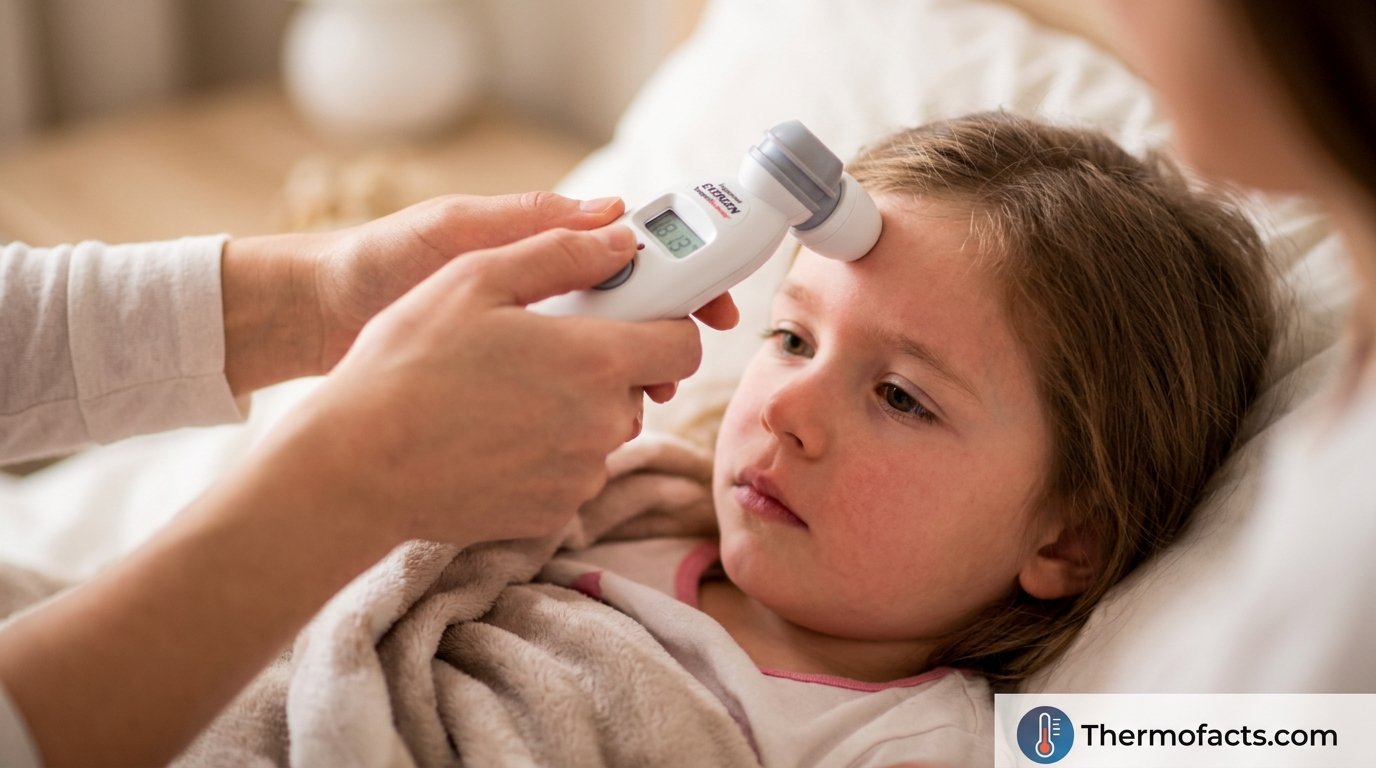
In practice, these devices come in two flavors: scanning models, which you gently swipe across the forehead from the center to the hairline near the temple, and non-contact models, which you simply hover a few centimeters above the skin and press a button. Both styles rely on infrared sensors and internal algorithms that adjust the surface-skin reading to estimate an equivalent core body temperature.
Temporal thermometers rose sharply in popularity because they are the least invasive option available — no ear canal insertion, no mouth placement, and for non-contact models, no skin contact at all. That last point made them a staple of workplace and school health screenings, where speed and non-contact hygiene matter as much as accuracy. If you’re curious how temporal readings stack up specifically against oral thermometers rather than ear thermometers, our comparison of forehead vs oral thermometers covers that angle in detail.
How Each Technology Works
Both ear and temporal thermometers rely on infrared sensors, but the physics behind each reading is subtly different, and understanding that difference explains a lot of the accuracy debates you’ll see online.
Ear Thermometer Mechanics
The probe tip of an ear thermometer houses an infrared sensor that detects thermal radiation emitted by the tympanic membrane and surrounding ear canal walls. The device’s internal processor converts that infrared signal into a temperature value, often applying a correction factor to approximate oral or rectal equivalence. Because the ear canal is a narrow, curved space, the angle of insertion dramatically affects how much of the sensor’s “field of view” actually lands on the eardrum versus the cooler canal walls — which is the single biggest reason ear thermometers produce inconsistent readings in inexperienced hands.
Temporal Thermometer Mechanics
A temporal artery thermometer’s infrared sensor scans across the skin, continuously sampling the highest heat signal it detects as it moves — the assumption being that the highest reading corresponds most closely to the artery itself rather than surrounding, slightly cooler skin. The device’s firmware runs this peak-detection logic in real time, then applies its own arterial-heat-balance algorithm to estimate core temperature. Non-contact temporal models skip the swiping motion entirely and instead average infrared readings from a small area of forehead skin, which introduces more room for error from ambient air temperature, sweat, or hair covering the forehead.
For a broader technical explanation of how infrared clinical thermometers process signals in general, our article on how a digital thermometer works breaks down the sensor technology used across nearly all modern non-contact and contact devices.
Accuracy Compared: What the Research Actually Shows
Accuracy is the question everyone actually cares about, so let’s be direct: neither ear nor temporal thermometers are as consistently accurate as a properly used oral or rectal thermometer, but both are considered clinically acceptable for general fever screening when used correctly.
Multiple clinical comparison studies conducted in pediatric and emergency settings have found that ear thermometers tend to slightly underestimate temperature compared to rectal readings, particularly in infants under three months old, where ear canals are narrower and harder to align properly. Temporal artery thermometers, meanwhile, have shown a tendency to produce readings that are close to rectal temperature in controlled clinical conditions, but their real-world accuracy drops noticeably when ambient temperature, sweating, or improper technique come into play — for example, taking a reading right after someone comes inside from cold weather.
In short: under ideal lab conditions, both device types perform respectably. In real, messy, at-home use — squirming toddlers, earwax buildup, drafty rooms — both devices show a wider margin of error, and the “winner” often comes down to which one *you* can use consistently correctly, more than which technology is inherently superior.
| Factor | Ear Thermometer | Temporal Thermometer |
|---|---|---|
| Typical accuracy range | ±0.3–0.5°F under ideal technique | ±0.2–0.5°F under ideal technique |
| Sensitive to user technique | Very high | Moderate to high |
| Affected by earwax / room temp | Earwax significantly affects readings | Room temperature and sweat affect readings |
| Best-validated age group | 6 months and older | 3 months and older (model dependent) |
| Clinical acceptance | Widely accepted for general screening | Widely accepted, common in institutional screening |
Ease of Use
This is where the two devices genuinely diverge in everyday experience. Ear thermometers require you to gently tug the outer ear (up and back for adults, down and back for infants) to straighten the ear canal before inserting the probe — a maneuver that takes some practice, especially with a wriggling child who does not want anything near their ear. Get the angle wrong, and the reading can be off by a full degree or more without any obvious sign that something went wrong.
Temporal thermometers, by contrast, are about as close to foolproof as clinical thermometry gets. Swiping a scanner across a forehead — or holding a non-contact model a few centimeters away — requires far less precision and cooperation from the person being measured. This is a major reason temporal thermometers became the default choice for sleeping infants, mass health screenings, and anyone trying to take a temperature without fully waking someone up.
If ease-of-use and minimal cooperation from the patient are top priorities, temporal thermometers generally win this category. If you already have steady hands and a device you’re used to, ear thermometers are just as manageable once the technique becomes second nature.
Speed of Reading
Both device categories are marketed as “one-second” or “two-second” thermometers, and in practice, both really are fast once properly positioned. The real speed difference shows up in total time-to-reading, not raw sensor speed. Ear thermometers often need a probe cover applied first, plus the ear-straightening maneuver, which adds a few seconds of prep before the actual one-second measurement. Temporal thermometers, especially non-contact models, need essentially no prep — power on, aim, press.
For a single reading on a cooperative adult, the time difference is negligible. For a fussy toddler at 3 a.m., the near-zero prep time of a temporal thermometer often makes it the more practical choice, even if the raw sensor speed is nearly identical.

See Top-Rated Temporal Thermometers
Compare best-selling forehead scanning and non-contact thermometers.
Check Price on AmazonHygiene & Cross-Contamination
In multi-person households, clinics, or schools, hygiene is a legitimate practical concern, not just a technicality. Ear thermometers typically require disposable plastic probe covers for each new user; skipping these covers (or reusing them) risks transferring earwax, bacteria, or debris between users and can also skew the sensor’s readings over time if the lens gets dirty.
Temporal thermometers, particularly non-contact models, largely sidestep this issue since the sensor never physically touches skin. Scanning (contact) temporal models do touch the forehead directly, so they still require wiping the sensor head with alcohol between users, but this is generally simpler and less wasteful than replacing probe covers for every reading.
For households managing a contagious illness, non-contact temporal thermometers offer a genuine hygiene advantage — you can take multiple family members’ temperatures without any physical contact between the device and skin, reducing the risk of spreading illness through the device itself.
Best Use Cases by Age and Situation
Newborns and Infants Under 3 Months
Most pediatricians recommend rectal thermometers as the gold standard for this age group because both ear and temporal readings can be less reliable in very young infants due to small ear canals and delicate skin. If you do use a non-contact option at this age, treat any reading suggesting fever as a reason to confirm with a rectal reading and call your pediatrician.
Infants 3–12 Months
Temporal thermometers tend to be easier here since they don’t require inserting anything into a small, sensitive ear canal, and many parents find them less likely to wake a sleeping baby.
Toddlers and Young Children
Both devices work reasonably well once a child is old enough to sit relatively still. Ear thermometers become more reliable as ear canals widen with age, typically from around 6 months onward.
Adults and Elderly Users
Both devices perform comparably well for adults. Elderly users with excess earwax buildup may see more skewed ear thermometer readings, making temporal thermometers a slightly safer default in that population.
Clinical and Institutional Settings
Non-contact temporal thermometers dominate mass-screening scenarios — schools, workplaces, airports — because of speed and zero physical contact, even though ear thermometers remain common in pediatric offices for individual patient visits.
Cost Comparison
Pricing for both categories spans a wide range depending on brand, accuracy claims, and additional features like memory storage or multi-mode (ear/forehead/object/room) functionality.
| Category | Ear Thermometer | Temporal Thermometer |
|---|---|---|
| Budget models | Entry-level, basic single-reading models | Entry-level non-contact scanners |
| Mid-range models | Includes fever alert colors, memory recall | Includes multi-mode object/room temp, memory recall |
| Premium models | Clinical-grade accuracy claims, app connectivity | Clinical-grade, used in hospital settings |
| Ongoing costs | Disposable probe covers (recurring cost) | Minimal to none (alcohol wipes only) |
When factoring in the recurring cost of disposable probe covers over years of use, temporal thermometers can end up being slightly cheaper in total cost of ownership, even if the upfront price of both device types is similar.
Pros and Cons
Ear Thermometer — Pros
- Fast, close-to-core readings when used correctly
- Well-established in pediatric clinical use
- Compact and easy to store
- Often includes fever-alert color indicators
Ear Thermometer — Cons
- Highly sensitive to insertion angle and technique
- Earwax buildup can distort readings
- Requires disposable probe covers (recurring cost)
- Less comfortable for uncooperative children
Temporal Thermometer — Pros
- Easy to use with minimal training
- Non-contact models offer excellent hygiene
- Won’t wake a sleeping infant or patient
- Low or no recurring consumable costs
Temporal Thermometer — Cons
- Sensitive to ambient room temperature and drafts
- Sweat, hair, or hats can affect scanning models
- Non-contact models can vary more between readings
- Requires steady, correct scanning motion for contact models
Common Mistakes That Ruin Accuracy
Ear Thermometer Mistakes
The most frequent error is failing to straighten the ear canal before insertion, which causes the sensor to read the cooler canal wall instead of the eardrum. Taking a reading immediately after someone has been lying on that ear, or right after removing a hat or earbuds, can also produce artificially elevated readings due to trapped heat.
Temporal Thermometer Mistakes
A common mistake with scanning models is moving the sensor too quickly across the forehead, which can cause it to miss the peak arterial heat signal. Taking a reading on a sweaty forehead, through hair, or immediately after coming indoors from cold or hot weather can also distort results. Non-contact models are especially sensitive to being held at an inconsistent distance from the skin — even a centimeter of variation between readings can shift the number.
Tip: For either thermometer type, take two or three readings and note the highest one, and always confirm any reading during illness by comparing it against how the person actually feels — a low-grade fever reading in an otherwise clearly ill person shouldn’t be dismissed just because the device says “normal.”
Which One Should You Buy?
If you’re a parent of an infant under a year old, or you regularly need to check temperatures on a sleeping child without waking them, a temporal thermometer is generally the more practical daily-use tool. If you want a device widely trusted in pediatric clinics with fast, close-to-core readings and don’t mind the small learning curve of ear positioning, an ear thermometer remains an excellent choice, particularly once your child is old enough to sit relatively still.
Many households, especially those managing frequent illness or multiple children, end up keeping both device types on hand — the ear thermometer for routine, deliberate checks, and a non-contact temporal thermometer for quick screening without disturbing a sleeping or resting family member. If you’d like to see current top-rated models across both categories before making a final decision, our roundup of the best digital thermometers compares several well-reviewed options side by side.

Prefer a 2-in-1 Device?
Some models measure both ear and forehead temperatures with one unit — see current options.
Check Price on AmazonMaintenance & Calibration Tips
Both device types benefit from periodic calibration checks, particularly if a reading seems suspiciously off compared to how the person feels. Many manufacturers recommend checking a thermometer’s accuracy against a known reference point occasionally — our guide on how to calibrate a digital thermometer walks through the process step by step for most digital models, including ear and temporal designs.
For ear thermometers, keep the sensor lens clean and free of earwax residue using a soft, dry cloth — never submerge the probe tip in water. Replace probe covers with each use and store spares in a dry place. For temporal thermometers, wipe the sensor window gently with a soft cloth or alcohol wipe, avoiding abrasive cleaners that could scratch the lens. Store both device types away from direct sunlight and extreme temperatures, since infrared sensors can drift in accuracy after being left in a hot car or near a sunny windowsill.
Replace batteries as soon as a low-battery indicator appears rather than waiting for the device to fail completely, since some models produce quietly inaccurate readings before batteries die entirely rather than shutting off outright.
Frequently Asked Questions
Which is more accurate, an ear thermometer or a temporal thermometer?
Neither is universally more accurate; both perform similarly well under ideal conditions, and accuracy in practice depends more on correct technique than on which technology is used.
Can I use a temporal thermometer on a newborn?
Many temporal thermometers are labeled for use from three months of age, but pediatricians generally still recommend rectal thermometers as the most reliable option for newborns under three months.
Why does my ear thermometer give different readings each time?
This is usually caused by inconsistent insertion angle, earwax buildup, or not fully straightening the ear canal before taking the reading.
Do non-contact temporal thermometers work through hair?
Hair can interfere with an accurate reading, so it’s best to scan an area of exposed forehead skin rather than through bangs or a hat.
How far should a non-contact thermometer be held from the forehead?
Most non-contact models recommend holding the device between one and three centimeters from the skin; check your specific model’s manual, since distance requirements vary by brand.
Can earwax affect ear thermometer readings?
Yes, significant earwax buildup can block the sensor’s view of the eardrum and produce a lower, inaccurate reading.
Is it normal for temporal and ear readings to differ slightly?
Yes, a difference of a few tenths of a degree between device types is common and doesn’t necessarily indicate a malfunction in either device.
Do I need to replace probe covers on an ear thermometer every time?
Yes, using a fresh probe cover for each person and each use helps maintain both hygiene and consistent sensor accuracy.
Which thermometer type is better for a sleeping baby?
A non-contact temporal thermometer is generally the better choice for checking a sleeping baby’s temperature without disturbing them.
Can I use these thermometers on the wrist or other body parts?
No, ear and temporal thermometers are specifically designed and calibrated for the ear canal or forehead area and will not produce reliable readings elsewhere on the body.
How often should I calibrate my thermometer?
Checking calibration every few months, or any time a reading seems inconsistent with how a person feels, is a reasonable practice for both device types.
Should I buy both an ear and a temporal thermometer?
Many households find value in owning both, using the ear thermometer for deliberate, precise checks and the temporal thermometer for quick, low-disturbance screening.
Final Verdict
There’s no single “winner” between ear and temporal thermometers — both are legitimate, widely trusted tools when used correctly, and both have specific situations where they clearly outperform the other. If your priority is speed, minimal disturbance, and hygiene, lean toward a temporal thermometer. If you want a device trusted in pediatric offices with a slightly steeper technique learning curve, an ear thermometer is a solid, reliable choice. For many families, owning one of each ends up being the most practical solution of all.
Shop Top-Rated Thermometers on Amazon



 Home
Home
 Info
Info
 Compare
 Reviews
 Shop
Shop