
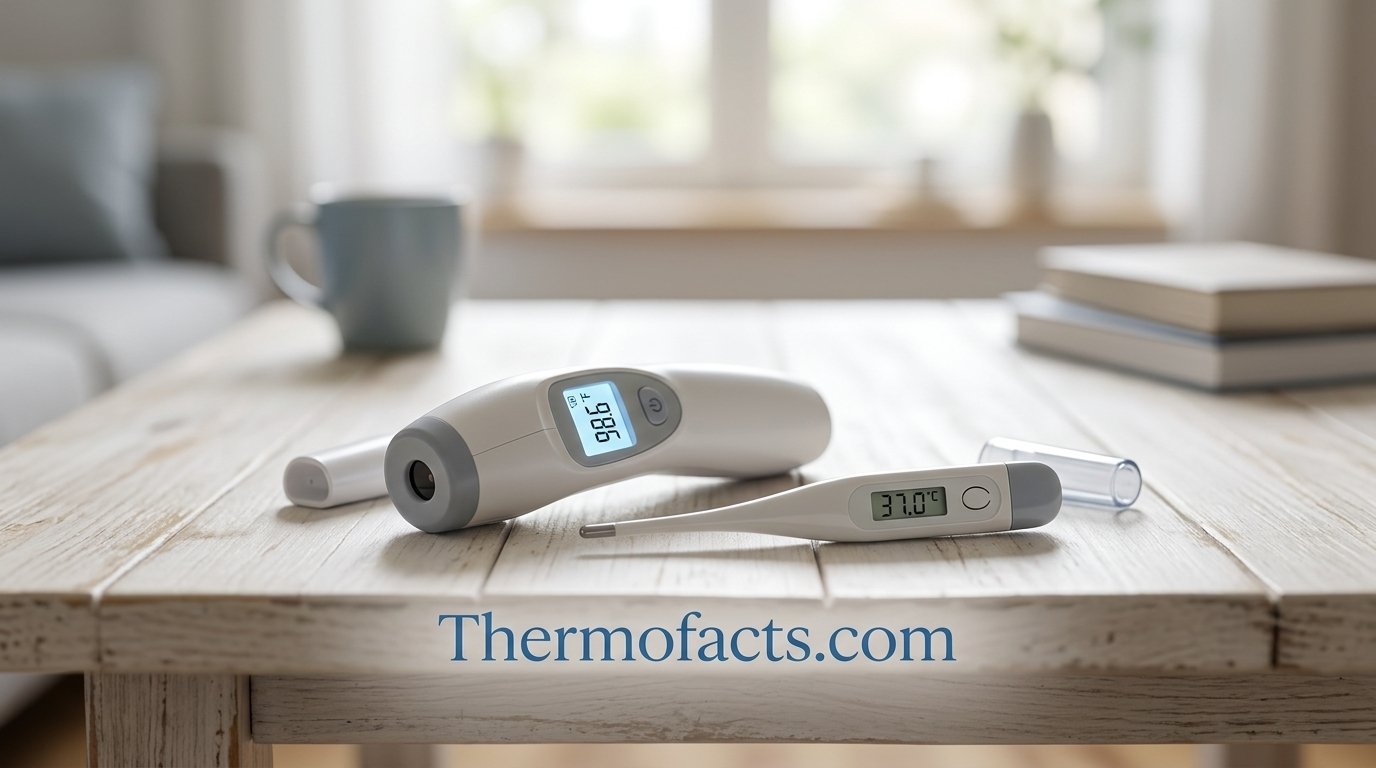
Forehead vs Oral Thermometer: Which One Should You Actually Trust?
A practical, no-fluff comparison of temporal (forehead) and oral thermometers — accuracy, speed, hygiene, and which one deserves a spot in your medicine cabinet.
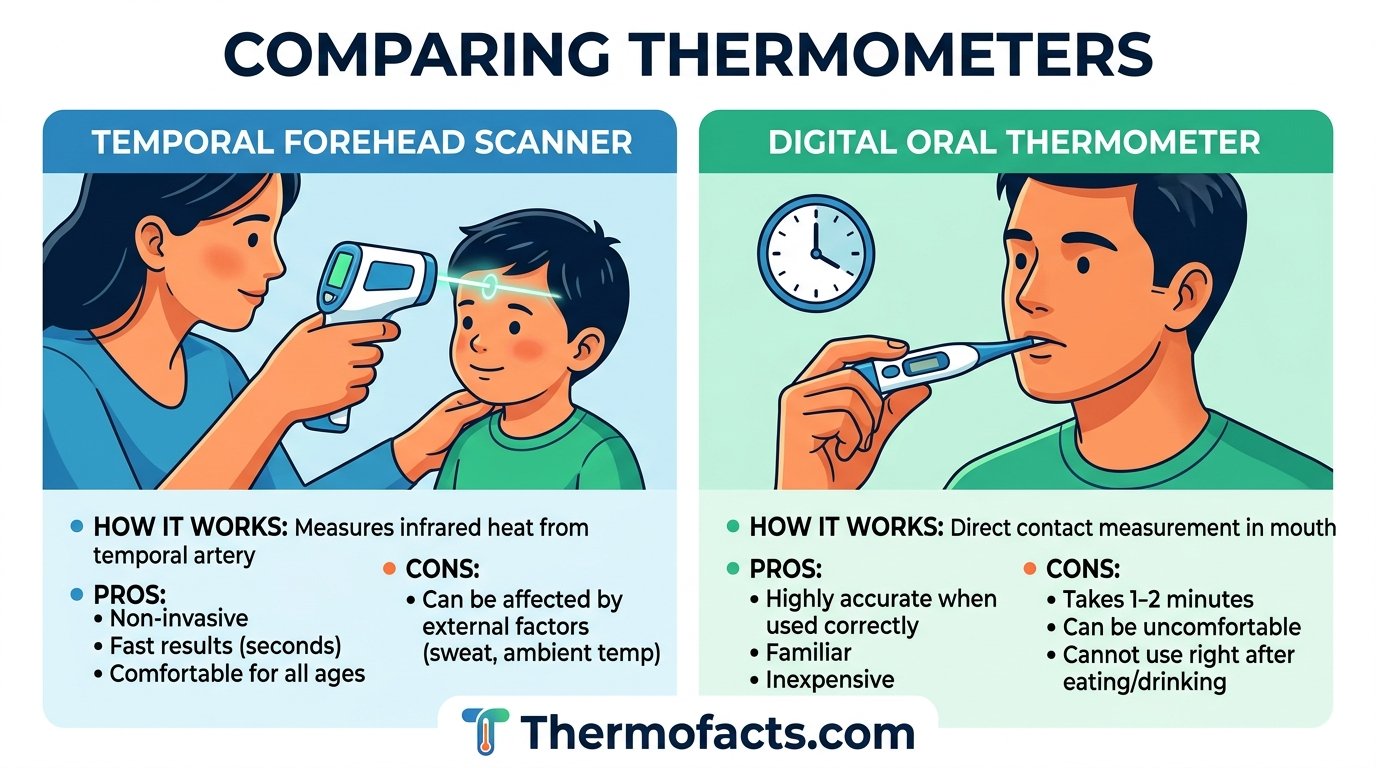
Somewhere between the third sleepless night with a feverish toddler and the fifth time you’ve second-guessed a thermometer reading, the same question always comes up: forehead or oral thermometer — which one is actually right for your family? Both tools promise fast, reliable temperature readings, but they work on completely different principles, and that difference matters a lot more than most product listings let on.
A forehead (temporal artery) thermometer reads infrared heat radiating off the skin near your temple in about one to three seconds, without ever touching your mouth. An oral thermometer, on the other hand, measures the actual temperature of tissue inside your mouth, which tends to track more closely with your body’s true core temperature — but it takes longer, requires cooperation, and isn’t practical for a squirming infant or someone who just finished a hot cup of coffee.
If you’re trying to figure out which one deserves a permanent spot in your medicine cabinet — or whether you need both — this guide breaks down everything from raw accuracy numbers to hygiene, cost, and which option makes sense for babies, kids, adults, and elderly family members. We’ll also touch on how these two compare to other options like ear thermometers, since the temporal-vs-tympanic debate often gets lumped into the same conversation.
Quick Verdict: The Short Answer
If you want the fastest possible answer without reading the rest of this guide, here it is: forehead thermometers win on speed, convenience, and hygiene, which makes them the better everyday pick for households with young kids. Oral thermometers win on raw accuracy when used correctly, which makes them the better choice for cooperative older kids, adults, and anyone who wants a second opinion when a forehead reading looks off.
| Category | Forehead Thermometer | Oral Thermometer |
|---|---|---|
| Reading Time | 1–3 seconds | 30–90 seconds (or longer for basic models) |
| Typical Accuracy Range | ±0.3–0.5°F under good conditions | ±0.1–0.2°F when used correctly |
| Best For | Infants, toddlers, sleeping patients, quick screening | Cooperative kids, adults, confirming a fever |
| Hygiene | No-contact or minimal skin contact | Requires cleaning between uses |
| Sensitivity to Conditions | Affected by sweat, drafts, room temperature | Affected by eating, drinking, mouth breathing |
| Typical Price | $15–$45 | $8–$20 |
Neither option is objectively “better” in every situation — they’re built for different moments. A parent taking a 2 a.m. reading from a sleeping baby needs speed and minimal disruption. A nurse confirming whether a patient’s fever has actually broken needs precision. Keep reading, and by the end you’ll know exactly which one fits your situation, or whether you should own both — which, honestly, is what most households with kids eventually end up doing.

Looking for a reliable forehead thermometer?
Non-contact infrared scanners are the fastest way to check a sleeping child’s temperature without waking them up.
Check Price on AmazonHow Forehead (Temporal Artery) Thermometers Work
A forehead thermometer, more precisely called a temporal artery thermometer, uses an infrared sensor to detect the heat radiating from the skin directly above the temporal artery — the blood vessel that runs across your forehead just under the skin. Because that artery sits close to the surface and carries blood straight from the heart, it gives a reasonably close approximation of core body temperature without any physical penetration into the body.
When you sweep the sensor across the forehead (or hold it steady, depending on the model), the device is essentially reading infrared radiation — the same kind of energy captured by thermal cameras — and converting it into a temperature estimate using a built-in algorithm. Some units also read from behind the ear, which tends to be less exposed to ambient air and sweat, and can offer a slightly more stable secondary reading.
To understand this technology more deeply, it helps to know how digital thermometers work in general, since forehead thermometers are really just a specialized branch of digital, sensor-based temperature measurement rather than the mercury-based devices of decades past.
Contact vs. Non-Contact Forehead Thermometers
Not all forehead thermometers work the same way. There are two main subtypes:
- Contact temporal thermometers: These require you to glide the sensor across the forehead while maintaining skin contact. They tend to be slightly more accurate because the sensor is measuring skin temperature directly rather than through a gap of air.
- Non-contact infrared thermometers: These hover 1–3 centimeters from the skin and never actually touch the person. They’re the fastest and most hygienic option, especially useful for sleeping infants, but they’re also more sensitive to environmental interference like drafts, humidity, and the distance you hold the device.
Non-contact models became especially popular in clinics, schools, and workplaces during large-scale temperature screening efforts, largely because they let staff check dozens of people quickly without touching each person or swapping disposable covers.
How Oral Thermometers Work
An oral thermometer measures temperature directly from tissue inside the mouth — specifically the sublingual pocket under the tongue, which sits close to the sublingual artery and tends to closely mirror core body temperature. Modern oral thermometers are almost universally digital, using a small thermistor (a temperature-sensitive resistor) at the tip of a probe. As the probe warms to match the tissue around it, the thermistor’s electrical resistance changes in a predictable way, and the device’s internal chip converts that change into a temperature reading on the display.
Most digital oral thermometers beep once they detect that the reading has stabilized, usually somewhere between 10 and 60 seconds, though cheaper models without predictive algorithms may ask you to hold the thermometer in place for longer to get a stable, non-fluctuating number.
If you’re curious about the mechanics of thermistor-based sensors specifically, our deep dive on what a digital thermometer actually is covers the underlying technology in more detail, including how it differs from older glass and mercury designs that are now largely phased out for safety reasons.
Why the Mouth Is Considered a Reliable Measurement Site
The mouth has long been considered one of the more dependable external measurement sites (alongside the rectum, which is generally the gold standard for infants) because the sublingual pocket is well-insulated from ambient air once the mouth is closed, and it sits close to major blood vessels. That combination gives oral readings a reputation for tracking closely with core temperature — provided the person hasn’t just eaten, drunk something hot or cold, chewed gum, or been breathing through their mouth beforehand, all of which can throw the reading off by a full degree or more.
Accuracy Compared: What the Numbers Actually Show
This is the question everyone actually cares about: which thermometer gives you a number you can trust? The honest answer is that both can be accurate — but oral thermometers, when used under ideal conditions, tend to edge out forehead thermometers in controlled comparisons, largely because they measure a more stable, better-insulated part of the body.
Clinical comparisons generally find oral thermometers accurate to within about ±0.1–0.2°F (0.1°C) of core body temperature when used correctly, while forehead thermometers typically land in the ±0.3–0.5°F range, and can drift further off if used improperly (held too far away, swept too quickly, or used on a sweaty or flushed forehead). That said, “accurate under ideal conditions” is doing a lot of work in that sentence — plenty of real-world factors can knock either device off course, which is why we’ve dedicated an entire section below to the variables that actually move the needle.
It’s also worth noting that oral thermometer accuracy depends heavily on placement. The probe needs to sit in the sublingual pocket on either side of the tongue’s base — not just anywhere under the tongue — and the mouth needs to stay closed the entire time. A thermometer held loosely between the lips, with the mouth cracked open, will consistently under-read.
Which Is More Consistent Reading-to-Reading?
Consistency (how close repeated readings are to each other) tends to favor oral thermometers slightly, simply because the measurement environment — an enclosed, insulated mouth — is more stable than an open forehead exposed to room temperature, wind, or sweat. If you’ve ever taken three forehead readings in a row and gotten three slightly different numbers, that’s a real phenomenon, not user error — it’s a known limitation of infrared skin-surface measurement.
Speed & Convenience
If accuracy is where oral thermometers pull ahead, speed and convenience are where forehead thermometers dominate — and for a lot of households, that trade-off is worth it. A non-contact forehead thermometer delivers a reading in one to three seconds, doesn’t require the person being tested to do anything at all, and works on someone who’s asleep, crying, or otherwise uncooperative.
Oral thermometers, by comparison, need active cooperation. The person has to keep their mouth closed and stay relatively still for anywhere from 10 seconds (on fast, predictive digital models) to a full 60–90 seconds on basic models. That’s manageable for most adults and older kids, but it’s a genuine obstacle with toddlers, anyone who’s confused or drowsy from illness, or a baby who simply can’t hold a thermometer under their tongue.
Forehead Wins When You Need:
- A reading from a sleeping child without waking them
- Quick screening of multiple people (school, workplace, event entry)
- A reading from someone uncooperative, confused, or in distress
Oral Wins When You Need:
- A confirmed, precise number for a doctor’s appointment
- Tracking small temperature changes over several hours
- A device with no line-of-sight or angle sensitivity
Best Use Cases by Age Group
Neither thermometer type is universally “best” — the right choice really does shift depending on who’s being measured. Here’s how the two stack up across common age groups.
Newborns and Infants (0–3 months)
For this age group, most pediatricians still recommend a rectal thermometer for the most accurate reading, since fever thresholds are taken very seriously in newborns. That said, a forehead thermometer is a reasonable, gentle way to do a quick check without disturbing a sleeping baby — especially as a first screening tool before deciding whether a more precise rectal reading is warranted. Oral thermometers are not usable at this age at all, since infants can’t hold a probe under the tongue.
Babies and Toddlers (3 months–3 years)
This is where forehead thermometers genuinely shine. Toddlers rarely sit still long enough for an oral reading, and non-contact scanners let you check a fussy or sleeping child in seconds. Many parents in this stage keep a forehead thermometer as their primary tool and only reach for an oral or rectal thermometer to confirm a borderline or unusually high reading.
Older Kids (4–12 years)
Once a child can reliably keep their mouth closed and hold still for 30–60 seconds, oral thermometers become a practical option and tend to give a more trustworthy number for anything borderline. Many families use forehead thermometers for quick daily checks and switch to oral readings when a fever needs to be tracked more precisely — say, monitoring whether medication is working.
Teens and Adults
For most healthy adults, either device works well, and the choice often comes down to convenience. Oral thermometers are cheap, accurate, and easy to use correctly at this age, making them a solid default. Forehead thermometers remain useful for quick checks, especially first thing in the morning or when you don’t want to wait around for a reading.
Elderly Family Members
For older adults, particularly those with memory issues, dentures, or difficulty holding a thermometer steady in their mouth, forehead thermometers tend to be more practical day-to-day. However, it’s worth knowing that baseline body temperature naturally trends slightly lower with age, so a “normal” 98.6°F reading may actually represent a mild fever in an elderly person — something worth discussing with a doctor rather than relying on a single number from either device.

Want a precise, budget-friendly oral thermometer?
A flexible-tip digital oral thermometer is inexpensive, easy to clean, and great for confirming borderline forehead readings.
Check Price on AmazonHygiene & Cross-Contamination
In households with more than one person getting sick — which is most households, eventually — hygiene becomes a real practical concern. This is one area where the two thermometer types differ significantly.
Non-contact forehead thermometers are the clear winner here. Because the sensor never touches skin, there’s essentially no risk of transferring germs between family members, which is exactly why these devices became the standard for temperature screening in schools, offices, and clinics. Contact-based forehead thermometers do touch the skin, but a quick wipe with an alcohol swab between uses is generally sufficient since skin-to-skin transfer risk is lower than mouth-to-mouth.
Oral thermometers require more diligence. Saliva can carry a meaningful amount of bacteria and viruses, so the probe needs to be cleaned — ideally with soap and water or an alcohol wipe — after every single use, especially in a household where the same thermometer is shared between multiple people. Many families solve this by assigning a dedicated oral thermometer to each person, or by using disposable probe covers, though covers can slightly reduce accuracy if not seated correctly.
Cost Comparison
Price is rarely the deciding factor between these two thermometer types, but it’s worth knowing what you’re actually paying for. Basic digital oral thermometers are among the cheapest medical devices you can buy, often available for under $10, and even higher-end models with flexible tips and memory functions rarely cross the $20 mark.
Forehead thermometers cost more because of the infrared sensor technology involved. Basic contact models start around $15, while feature-rich non-contact models with silent mode, fever alarms, and multi-mode functionality (forehead plus object/room temperature) can run $30–$45. Clinical-grade models used in medical offices can cost significantly more, but those aren’t necessary for home use.
| Thermometer Type | Budget Option | Mid-Range | Premium |
|---|---|---|---|
| Oral Digital | $6–$10 | $10–$15 | $15–$20 |
| Forehead (Contact) | $12–$18 | $18–$28 | $28–$35 |
| Forehead (Non-Contact IR) | $18–$25 | $25–$35 | $35–$45+ |
Given the price gap, many households find the smartest move is buying an inexpensive oral thermometer as a backup or confirmation tool, and investing a bit more in a reliable non-contact forehead thermometer for everyday quick checks. If you want to compare specific models before buying, our roundup of the best digital thermometers breaks down real options across price points.
Forehead Thermometer: Pros & Cons
Pros
- Extremely fast — results in 1–3 seconds
- Works on sleeping or uncooperative patients
- No physical contact required (non-contact models)
- Low cross-contamination risk between family members
- Easy for anyone to use with minimal training
Cons
- More sensitive to environmental conditions (drafts, sweat, room temp)
- Slightly lower accuracy than oral in controlled comparisons
- Non-contact models require correct distance and angle
- Generally more expensive than basic oral thermometers
- Not usable on very young newborns as a sole diagnostic tool
Oral Thermometer: Pros & Cons
Pros
- Generally more accurate under proper use
- Very affordable, even for premium models
- More consistent reading-to-reading
- Simple, well-understood technology
Cons
- Requires cooperation and stillness for accurate results
- Not usable on infants or very young toddlers
- Skewed easily by recent food, drink, or mouth breathing
- Requires cleaning between every use
- Slower than forehead scanning, especially on basic models
Factors That Skew Your Reading (For Both Types)
A lot of “my thermometer is broken” complaints are actually user or environment error rather than a faulty device. Here’s what commonly throws off each type.
What Skews Forehead Readings
- Sweat on the forehead: Evaporating sweat cools the skin surface, which can produce an artificially low reading.
- Cold air or drafts: Coming inside from cold weather, or sitting near an air conditioner, can temporarily lower forehead skin temperature.
- Hair or bangs covering the temple: This blocks the sensor from reading the correct spot.
- Incorrect distance: Non-contact models specify an exact distance range (usually 1–3 cm); holding it too far away introduces error.
- Makeup or lotion on the forehead: Certain products can interfere with infrared reflection.
What Skews Oral Readings
- Eating or drinking beforehand: Wait at least 15–20 minutes after consuming anything hot or cold.
- Mouth breathing: Someone with a stuffy nose breathing through their mouth will often register a lower, less accurate reading.
- Talking during measurement: Opening the mouth mid-reading lets in ambient air and restarts the stabilization process.
- Incorrect probe placement: The tip needs to sit in the sublingual pocket, not just loosely under the tongue.
- Chewing gum immediately prior: Can slightly raise mouth temperature from friction and jaw movement.
Understanding these variables also matters if you’re comparing results against an ear thermometer reading, since tympanic devices have their own separate set of accuracy quirks (mainly earwax buildup and improper ear canal alignment).
Which One Should You Buy? A Scenario-Based Guide
Rather than a single universal recommendation, here’s how to think about the decision based on your actual household situation.
Buy a Forehead Thermometer If…
- You have infants or toddlers and need quick, low-disruption readings
- You want to screen multiple family members quickly during flu season
- Hygiene and shared-device cross-contamination are a top concern
- You’re willing to spend a bit more for speed and convenience
Buy an Oral Thermometer If…
- You mainly need accurate readings for yourself or cooperative older kids/adults
- You’re on a tight budget and want a reliable, no-frills option
- You need to track subtle temperature changes over time (e.g., illness monitoring)
- You want a simple backup device to confirm borderline forehead readings
Buy Both If…
Honestly, this is where most families with kids of varying ages eventually land. A forehead thermometer handles the fast, everyday, low-drama checks — especially for younger children — while a cheap oral thermometer sits in the cabinet as a confirmation tool whenever a forehead reading looks unusually high or a doctor’s visit calls for a more precise number. Given that a basic oral thermometer costs less than a takeout dinner, owning both isn’t a major investment, and it removes almost all the guesswork described in the accuracy section above.
How to Get the Most Accurate Reading From Either Device
For Forehead Thermometers
- Wipe away any visible sweat from the forehead before scanning.
- Move hair or bangs away from the temple area.
- For contact models, glide slowly and steadily across the forehead in one smooth motion.
- For non-contact models, hold the device at the exact distance specified in the manual — usually 1–3 cm.
- Avoid taking a reading immediately after coming in from outside temperature extremes; wait about 10–15 minutes to acclimate.
- Take two readings and compare — if they differ significantly, a third reading (or a switch to oral) is worth doing.
For Oral Thermometers
- Wait at least 15–20 minutes after eating, drinking, or chewing gum.
- Place the probe tip in the sublingual pocket, to one side of the center of the tongue.
- Close the lips fully around the thermometer — no talking or mouth-opening mid-reading.
- Breathe through the nose, not the mouth, for the duration of the reading.
- Wait for the audible beep confirming a stable reading rather than removing it early.
- Clean the probe with soap and water or an alcohol wipe after every use.
If your readings still seem inconsistent after following these steps, it may be worth checking whether your device needs recalibration. Our guide on how to calibrate a digital thermometer walks through a simple ice-water test you can run at home to check whether your thermometer is reading accurately.

Want the best of both worlds?
Some combo kits pair a non-contact forehead scanner with a spare oral probe, giving you speed and a precision backup in one purchase.
Check Price on AmazonFrequently Asked Questions
Is a forehead thermometer as accurate as an oral thermometer?
Not quite, under ideal conditions oral thermometers are usually more accurate, typically within ±0.1–0.2°F, compared to ±0.3–0.5°F for forehead thermometers. In everyday use, though, a properly used forehead thermometer is accurate enough for routine fever screening, especially when you compare two or three consecutive readings rather than relying on a single scan.
Why does my forehead thermometer give a different reading than my oral thermometer?
This is expected and normal. Forehead readings tend to run slightly lower than oral or rectal readings because skin temperature is naturally cooler than core body temperature. Many doctors suggest adding roughly 0.5–1°F to a forehead reading to approximate an oral equivalent, though you should always follow your device’s specific manual, since some models already apply this adjustment automatically.
Can I use a forehead thermometer on a newborn baby?
You can use one for a quick, gentle screening, but most pediatricians still recommend a rectal thermometer as the most accurate method for babies under three months old, since fever in that age range is treated with extra caution. Use a forehead reading as a first check, and follow up with a rectal reading if it seems elevated or your baby seems unwell.
How long after eating should I wait before using an oral thermometer?
Wait at least 15 to 20 minutes after eating, drinking, or chewing gum. Hot or cold foods and beverages can temporarily raise or lower the temperature inside your mouth, throwing off the reading in either direction.
Do forehead thermometers work through hair or bangs?
No. Hair covering the temple area blocks the infrared sensor from reading actual skin temperature, which can produce an inaccurate result. Always move hair away from the forehead and temple before taking a reading.
Which thermometer is better for a household with multiple kids?
A non-contact forehead thermometer is usually the more practical everyday choice for multi-kid households, since it avoids cross-contamination between siblings and works quickly on sleeping or uncooperative children. Keeping an inexpensive oral thermometer as a backup for confirming borderline readings is a smart complementary strategy.
Can sweat really affect a forehead thermometer reading?
Yes. As sweat evaporates from the skin, it has a cooling effect, which can make a forehead reading appear lower than the person’s actual temperature. Wiping the forehead dry before scanning helps produce a more accurate result.
How often should I clean my oral thermometer?
After every single use, especially if it’s shared between family members. Clean the probe with soap and water or an alcohol wipe, then let it air dry before storing it in its case to avoid bacterial buildup.
Is a non-contact forehead thermometer more accurate than a contact one?
Not necessarily. Contact temporal thermometers, which touch the skin directly, are often slightly more accurate than non-contact models because they eliminate distance and angle as variables. Non-contact models offer better hygiene and convenience, but they require more careful, consistent technique to get reliable results.
What temperature is considered a fever on each type of thermometer?
Generally, an oral reading of 100.4°F (38°C) or higher is considered a fever. Because forehead readings tend to run lower, many manufacturers set their fever threshold slightly lower, often around 99.5–100°F, but you should always check your specific device’s manual, since thresholds can vary by brand and model.
Should I buy both a forehead and an oral thermometer?
For most families, yes. A forehead thermometer covers fast, everyday checks, especially for young kids, while a low-cost oral thermometer serves as an accurate backup for confirming a fever or tracking small changes over time. Together they cover nearly every scenario a household is likely to run into.
Why do I get a different number every time I use my forehead thermometer?
Small variations between consecutive forehead readings are common because the device is measuring surface skin temperature, which is more sensitive to sweat, room temperature, and scanning technique than internal measurements. If you’re seeing large swings (more than a full degree), try re-checking with the forehead dry, hair moved aside, and the device held at the correct distance, or confirm with an oral reading.
The Bottom Line
Forehead and oral thermometers aren’t really competing for the same job — they’re solving two different problems. Forehead thermometers give you speed, convenience, and low cross-contamination risk, which makes them the practical everyday choice for households with young kids. Oral thermometers give you a more precise, dependable number when accuracy matters most, whether that’s confirming a fever before calling the doctor or tracking whether medication is actually bringing a temperature down. If your budget and cabinet space allow for it, keeping one of each covers nearly every situation you’re likely to run into.
Browse Top-Rated Thermometers on Amazon



 Home
Home
 Info
Info
 Compare
 Reviews
 Shop
Shop