
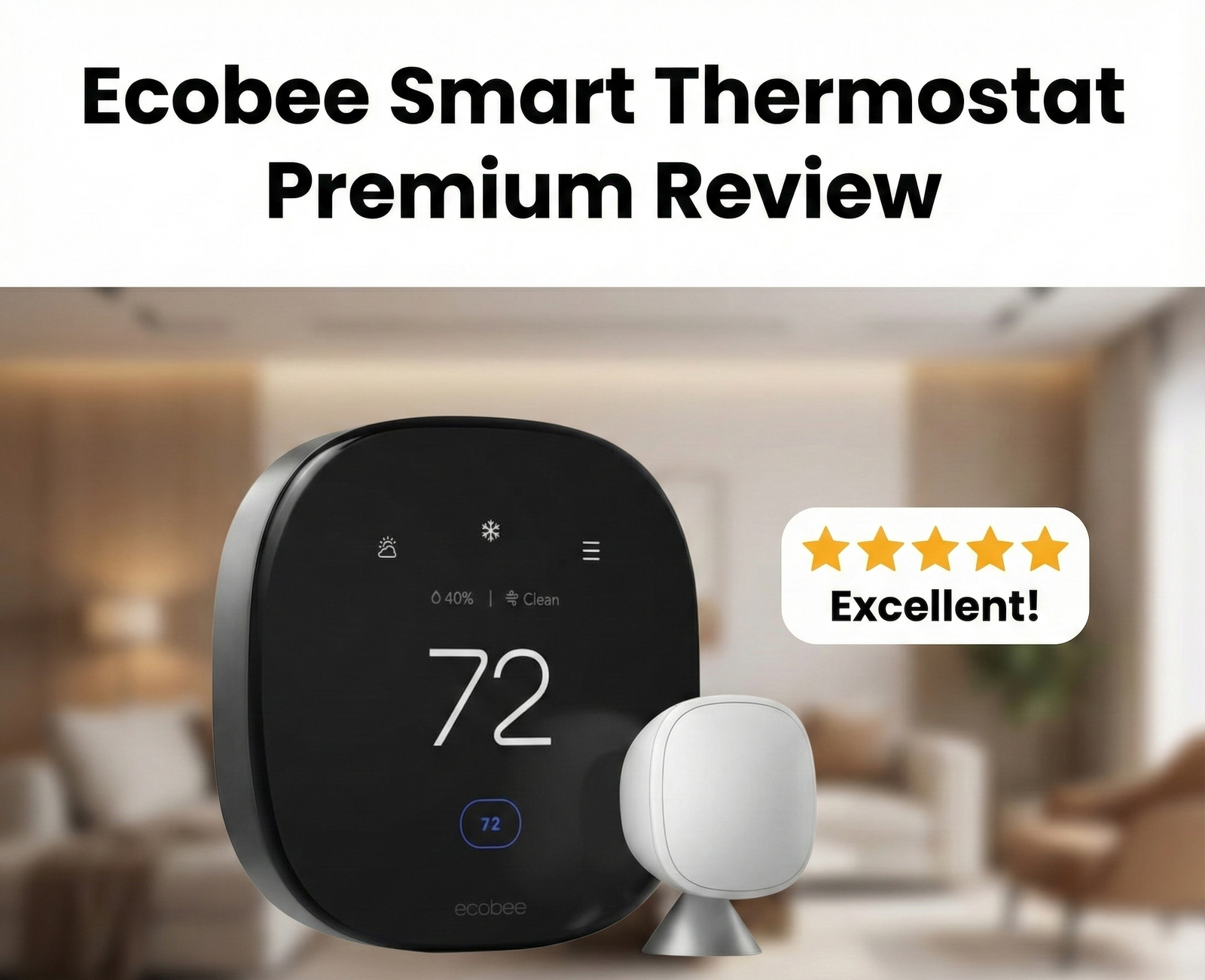
Ecobee Smart Thermostat Premium Review: Is It Worth the Upgrade?
The thermostat landscape has shifted dramatically. Gone are the days of the beige plastic dial that you simply ignored until you were freezing. Today, the Ecobee Smart Thermostat Premium promises to be more than just a temperature controller; it positions itself as a home security hub, an air quality monitor, and a smart speaker all wrapped in zinc and glass. But with a price tag significantly higher than its competitors, is it truly the best option for your home? In this comprehensive review, we strip down the marketing hype to test performance, installation, and real-world energy savings.
The Evolution of the Smart Thermostat
When we look at the history of climate control, Ecobee has consistently been the pioneer of the “remote sensor” concept, solving the age-old problem of hot and cold spots in a house. While many users are still debating Nest vs Ecobee thermostats, the release of the Premium model attempts to end the argument by adding features that Google’s Nest simply doesn’t have.
The “Premium” isn’t just a fancy name. Ecobee has overhauled the design, moving away from plastic to premium materials, and integrated a radar sensor for advanced occupancy detection. For homeowners who have thermostat explained to them as simple switches, this device is a massive leap forward. It acts as a bridge between comfort, health, and security.

Design & User Interface: A Glass Act
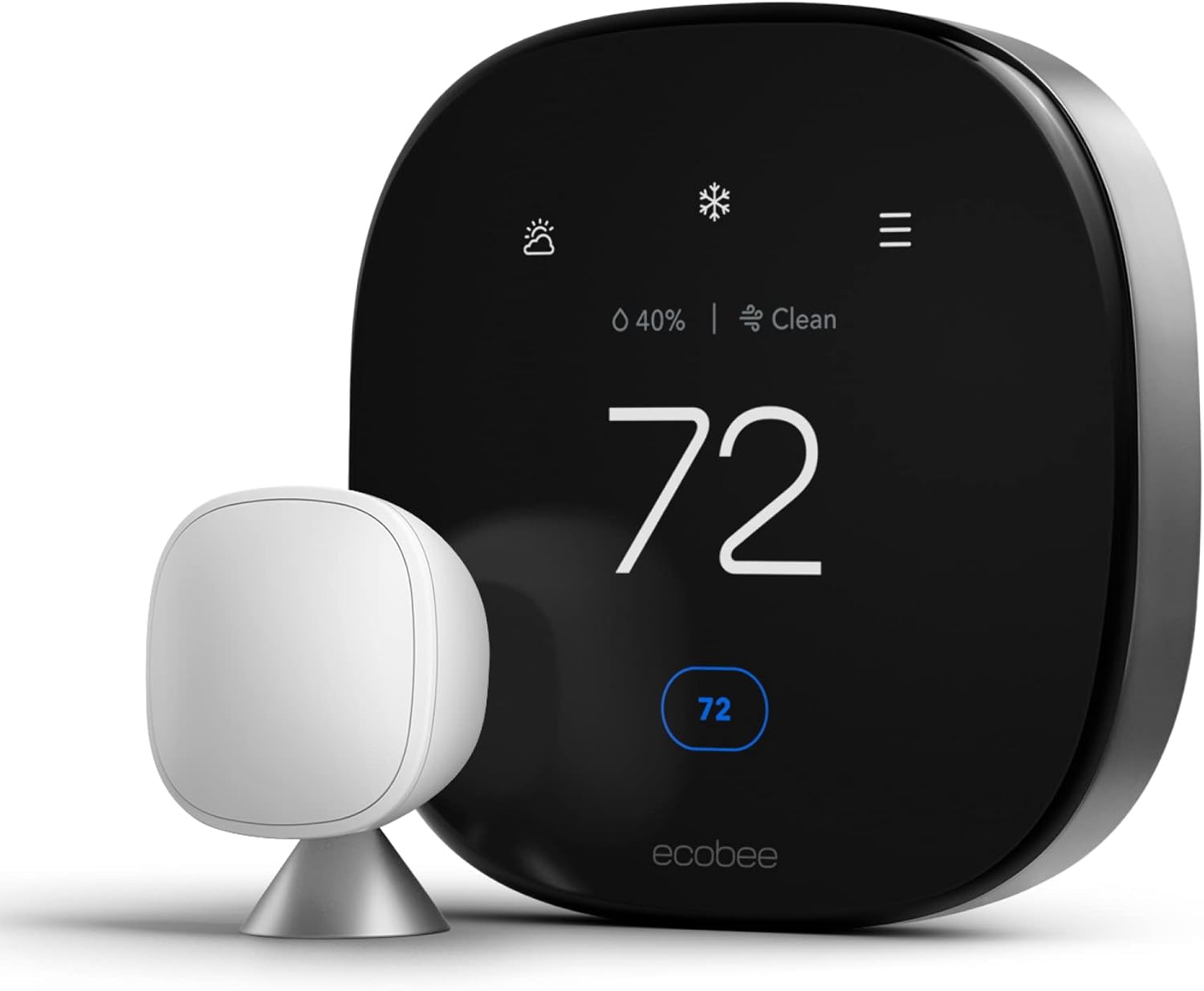
The first thing you notice when unboxing the Ecobee Smart Thermostat Premium is the build quality. Unlike the Ecobee vs Wyze thermostat comparison where plastic dominates, the Premium features a zinc body and a smooth glass face. It feels substantial in your hand—more like a piece of modern jewelry than an HVAC component.
The screen is a 4-inch color touch display with 540 x 540-pixel resolution. It is noticeably sharper than previous generations. The user interface (UI) has been refreshed to be more intuitive, with larger temperature readouts and easier access to humidity and air quality data.
Radar Technology
One of the subtle but major upgrades is the shift from PIR (Passive Infrared) to Radar technology. Why does this matter? Old sensors required you to walk directly in front of them to “wake up” the screen. The radar sensor detects presence from further away and around corners, lighting up the display as you approach. It feels futuristic and responsive.
Physical Dimensions and Footprint
Beyond how it looks on your wall, it’s worth understanding exactly how much space the Ecobee Smart Thermostat Premium occupies, especially if you’re covering up a larger legacy thermostat or an old paint outline. The unit measures 4.09 inches wide by 4.09 inches tall, with a depth of 1.02 inches once mounted on its backplate. That square, rounded-corner profile is a deliberate design choice — it’s compact enough to disappear into a hallway wall, yet the glass face is large enough that the “72” temperature readout is legible from across a room.
If you’re replacing an older, boxier thermostat, this smaller footprint sometimes means you’ll see a faint outline or unpainted patch on the wall around the edges. It’s worth keeping a small can of touch-up paint handy, or planning to use the included trim kit / backplate to cover the discrepancy. Because the depth is just over an inch, the thermostat also doesn’t protrude awkwardly from the wall the way some older mechanical units did, which matters if the thermostat sits in a narrow hallway where people might brush past it.

Materials, Finish, and Everyday Feel
Materials matter more than most buyers expect. A metal chassis dissipates the small amount of heat generated by the internal processor and Wi-Fi radio more evenly than plastic, which in theory helps keep the internal temperature sensor from being skewed by its own electronics. The glass face is also simply nicer to touch — swipes and taps register cleanly, and fingerprints wipe off easily with a microfiber cloth, unlike the matte plastic finishes on many budget thermostats that show smudges permanently within a few weeks.
The overall design language also signals why Ecobee has picked up so much recognition from third-party reviewers and award panels. It doesn’t look like a gadget bolted onto your wall — it looks like a considered piece of home hardware, which is part of why interior designers and smart-home enthusiasts alike tend to gravitate toward it over the utilitarian look of many competing units.
Award-Winning Technology: Why the Accolades Matter
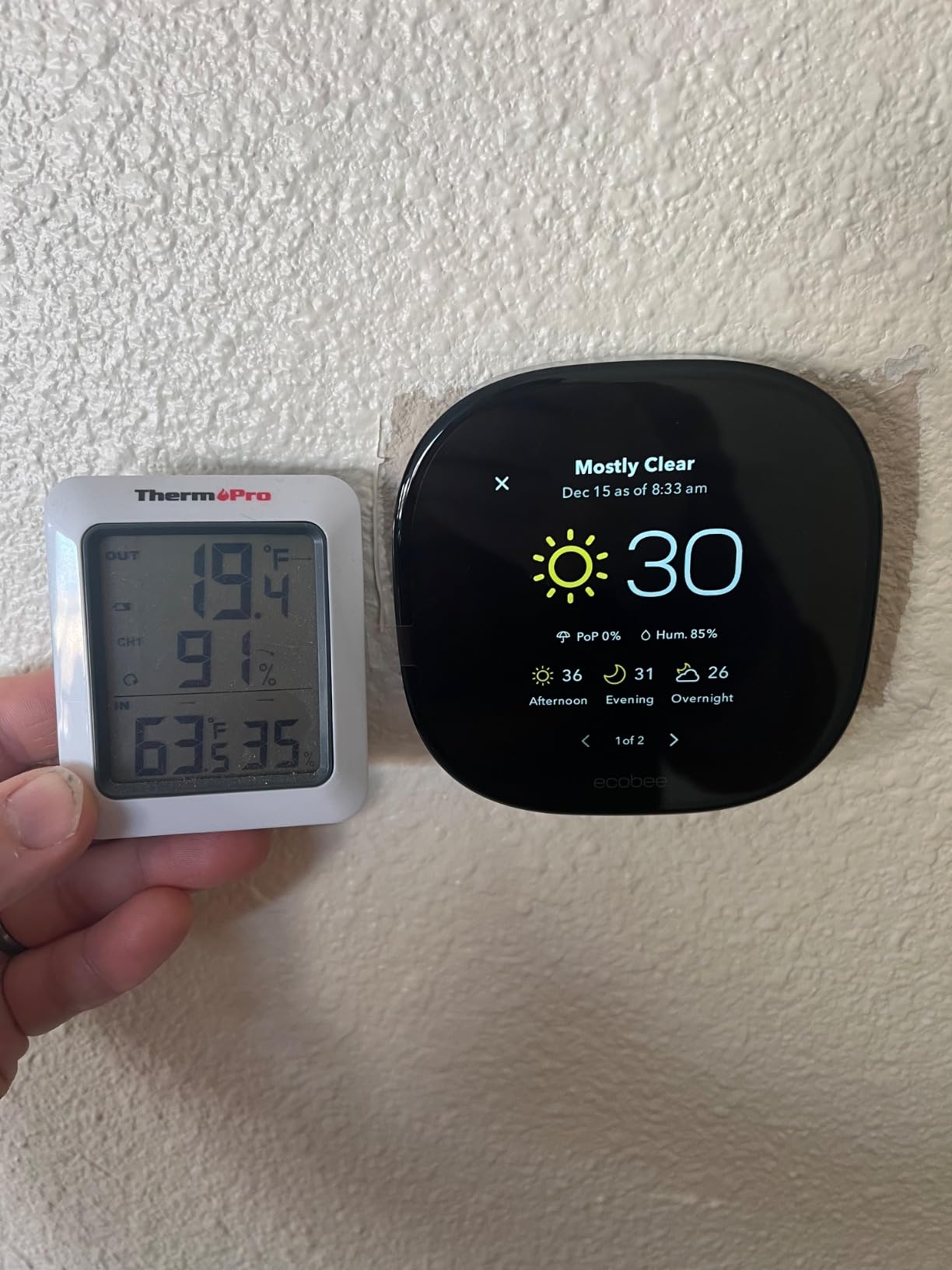
It’s easy to dismiss marketing badges as fluff, but in the case of the Ecobee Smart Thermostat Premium, the recognition comes from a genuinely diverse set of testing houses — meaning the device isn’t just winning on one axis (say, design) while quietly failing on another (say, real-world reliability). Understanding what each award actually measures helps explain why this thermostat keeps showing up on “best of” lists year after year.
TIME Best Inventions
TIME’s Best Inventions list recognizes products that meaningfully push a category forward, not just iterate on it. Ecobee’s inclusion reflects the shift from “thermostat as a dial” to “thermostat as a whole-home sensor platform” — the combination of radar occupancy detection, indoor air quality monitoring, and smart home hub functionality in a single wall-mounted unit was, at the time, a genuine step change rather than a marginal spec bump.
Newsweek Editors’ Choice
An Editors’ Choice award from a general-interest publication like Newsweek typically weighs ease of use as heavily as raw feature count. This matters for a thermostat because the single biggest failure mode of smart home devices isn’t a lack of features — it’s a UI so confusing that non-technical household members refuse to use it, or accidentally set the wrong schedule. Ecobee’s touch interface and companion app appear to have cleared that bar convincingly.
Tom’s Guide Awards
Tom’s Guide leans heavily on hands-on lab testing, including energy monitoring accuracy, sensor responsiveness, and app stability over weeks of use rather than a single unboxing session. A win here is a reasonably strong signal that the thermostat holds up under sustained daily use, not just in a first-impressions demo.
The New York Times Wirecutter Pick
Wirecutter is arguably the most rigorous mainstream product review outlet for home goods, and its “Our Pick” designation typically follows extensive side-by-side testing against every major competitor in the category, including price-to-feature analysis. Being named the pick over the Nest Learning Thermostat and Honeywell’s lineup, as reflected in the 2025 recognition, is a meaningful data point for anyone comparing Nest vs Ecobee thermostats and trying to decide where to spend their money.
ENERGY STAR Certification
Perhaps the most practically important badge is the ENERGY STAR certification. This isn’t a subjective editorial opinion — it’s a program administered against defined efficiency criteria set by the U.S. Environmental Protection Agency. For the Ecobee Premium, ENERGY STAR certification means the device has been independently verified to deliver measurable energy savings when used with its default settings, which is relevant if you’re hoping to offset the higher upfront cost through utility rebates. Many utility companies offer instant or mail-in rebates specifically for ENERGY STAR certified smart thermostats, so it’s worth checking your provider’s website before you buy.

Installation: Easier Than You Think
Many homeowners are intimidated by wiring, fearing they might break their HVAC system. However, Ecobee has arguably the best guided installation process in the industry. The app walks you through everything with diagrams.
The C-Wire Solution
A common issue with smart upgrades is power. If you check your current unit and see thermostat low battery symptoms, you likely lack a “Common” wire (C-wire) that provides constant power. Ecobee includes a Power Extender Kit (PEK) in the box. This small adapter installs at your furnace control board to power the thermostat without running new cables through your walls.
If you are replacing an older model, the process is straightforward. For example, we have a specific guide on how to switch out an hz311 thermostat for an ecobee thermostat, which demonstrates just how adaptable the Ecobee backplate is.
Note for High Voltage Systems: This thermostat is designed for low-voltage (24V) systems. If you are looking for a thermostat for baseboard heaters (high voltage), the Ecobee Premium will not work. You should look into alternatives like the Mysa Smart Thermostat review for those specific needs.
What’s Actually in the Box
One reason Ecobee’s install process feels painless compared to piecing together parts yourself is that the box is genuinely comprehensive. Rather than shipping a bare thermostat and expecting you to source your own hardware, Ecobee includes everything needed for a full, professional-feeling install: the thermostat unit itself, a wall backplate with a built-in bubble level, a labeled wire terminal block, the Power Extender Kit (PEK) with its own wiring leads, a trim plate to cover any gaps or old paint marks left by your previous thermostat, mounting screws and wall anchors for both drywall and plaster, a small screwdriver, wire labeling stickers so you can mark each terminal before you disconnect your old unit, and a printed quick-start guide that mirrors the in-app instructions step by step.
The included SmartSensor also ships pre-paired in the box on Premium bundles, along with its small tabletop stand and mounting bracket, so there’s no separate pairing process required for the first sensor — it’s typically detected automatically the moment the thermostat completes its initial setup.
This “everything included” approach is a meaningful differentiator when you compare total cost of ownership against competitors. As the comparison table above shows, the Nest Learning Thermostat does not include a remote sensor in the box, meaning you’ll need to buy one separately if you have rooms with uneven temperatures — an extra cost that isn’t always obvious at the point of purchase.
Step-by-Step: What the App Actually Walks You Through
To demystify the process further, here’s roughly what the guided setup looks like in practice, based on our installation:
- Photograph your existing wiring. Before you touch anything, the app has you take a photo of your current thermostat’s wire terminals. This becomes your reference if anything goes wrong.
- Label each wire. Using the included stickers, you label each wire according to its current terminal (R, C, W, Y, G, etc.) before disconnecting anything.
- Remove the old thermostat and mount the backplate. The backplate has a built-in level, so you don’t need a separate tool to make sure it’s straight.
- Connect wires to the new terminal block. The app cross-references the equipment type table (like the compatible systems table above) with the wires you’ve photographed, and tells you exactly which terminal each wire goes into.
- Install the Power Extender Kit if needed. If you don’t have a C-wire, this is the point where you’ll install the PEK at your furnace or air handler control board.
- Snap on the thermostat and power up. The unit boots, checks its own wiring configuration, and flags any potential issues — for example, if it detects a wire in an unexpected terminal.
- Connect to Wi-Fi and create your ecobee account. This is also where you’ll pair any SmartSensors and register the thermostat for its included Alexa/Siri voice features.
The whole process, for a straightforward single-stage system, generally takes less time than most people expect — often well under an hour including the time spent reading each screen carefully.
Full Equipment Compatibility Breakdown
Ecobee states the Premium is compatible with roughly 95% of residential 24VAC HVAC systems, which is a notably higher compatibility rate than the Enhanced (90%) or Essential (85%) models in the lineup — largely because the Premium ships with the Power Extender Kit included by default rather than as a separate purchase. Still, “95% compatible” is a broad claim, so it’s worth understanding exactly which system types are supported and how many wires each configuration requires. The table below breaks down the wiring requirements for the most common residential setups.
| Equipment Type | Supported | # of Wires | Wires Needed |
|---|---|---|---|
| Single Stage Heating & Cooling (with C-wire) | Yes | 5 | R, C, W1, Y1, G |
| Single Stage Heating & Cooling (no C-wire) | Yes | 4 | R, W1, Y1, G (requires PEK) |
| Multistage Heating & Cooling | Yes | up to 7 | R, C, W1, W2*, Y1, Y2*, G |
| Boiler Radiant Heating Only | Yes | 3 | R, C, W1 |
| Furnace Forced-Air Heating Only | Yes | up to 4 | R, C, W1, G* |
| Cooling Only (with C-wire) | Yes | 4 | R, C, Y1, G |
| Cooling Only (no C-wire) | Yes | 3 | R, G, Y (requires PEK) |
| Heat Pump with Auxiliary Heat (with C-wire) | Yes | up to 8 (up to 7 with PEK, no C-wire) | R, C, Y1, Y2*, W1, W2*, G, O/B |
| Heat Pump w/o Auxiliary Heat (with C-wire) | Yes | up to 6 (up to 5 with PEK, no C-wire) | R, C, Y1, Y2*, G, O/B |
| Gas Fireplace (24 Volts) | Yes | 3 | R, C, W1 |
| Dual Fuel/Hybrid Heating (with C-wire) | Yes | up to 8 | R, C, Y1, Y2*, W1, W2*, G, O/B |
| Dual Fuel/Hybrid Heating (no C-wire) | Yes | up to 7 | R, Y1, Y2*, W1, W2*, G, O/B (requires PEK) |
The asterisked wires (W2*, Y2*, G*) indicate terminals that are only required if your equipment actually uses a second stage of heating or cooling, or if your furnace fan is wired independently. If you’re not sure which category your home falls into, the safest approach is to photograph your existing thermostat’s wiring exactly as described in the step-by-step section above, then cross-reference it against this table, or use ecobee’s online compatibility checker before you buy. This is especially important for households with less common configurations, such as dual-fuel systems that pair a heat pump with a gas furnace, or older boiler-based radiant heat setups that only use three wires.
It’s also worth noting that heat pump systems are where compatibility questions come up most often, because heat pumps use the O/B terminal to reverse the refrigerant cycle between heating and cooling — a wire that traditional furnace-only systems simply don’t have. If your home uses a heat pump with auxiliary or emergency heat strips, make sure whichever thermostat you choose explicitly lists heat pump auxiliary heat support, since not every budget smart thermostat handles staged heat pump auxiliary heat correctly.
The “Premium” Difference: Air Quality & Smart Sensors
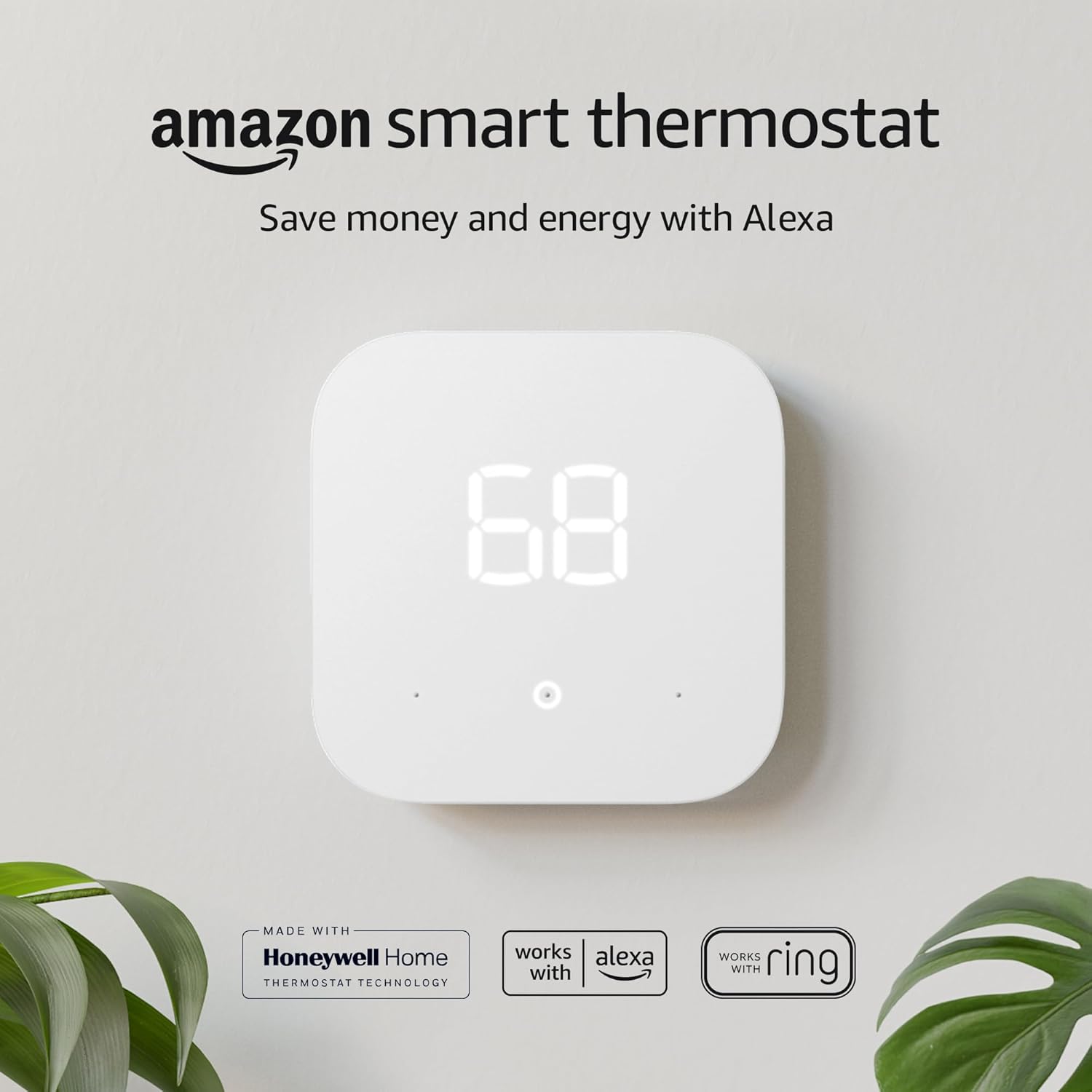
This is where the Ecobee Premium separates itself from the pack, including the standard Amazon Smart Thermostat review units.
Indoor Air Quality (IAQ) Monitor
Built directly into the device is a sensor that measures Volatile Organic Compounds (VOCs) and estimated Carbon Dioxide (CO2) levels. If you’ve been cooking without a vent or if the house feels stuffy, Ecobee alerts you. While it cannot clean the air unless you have a ventilator hooked up to your HVAC, the awareness it provides is valuable. It moves the conversation from “is it hot enough?” to “is the air healthy?”
SmartSensor Included
The package comes with one SmartSensor. You place this in a room that usually gets too hot or cold (like a bedroom over the garage). The thermostat can then average the temperature between the hallway and that bedroom, or prioritize the bedroom at night. If you are struggling with a thermostat not reaching set temperature in specific zones, this sensor is the solution. It essentially fixes balancing issues without expensive ductwork.
Smart Security: The Feature Most Reviews Overlook
One of the least talked about but genuinely differentiating aspects of the Ecobee Smart Thermostat Premium is its role as an entry point into Ecobee’s Smart Security ecosystem. On paper this might sound like scope creep — why does a thermostat need to know about home security? — but once you actually use it, the logic clicks into place quickly: your thermostat is already a network-connected device sitting in a central hallway with built-in motion and occupancy sensors, a microphone, and a speaker. Ecobee has simply extended those existing components into a lightweight home security layer.
In practice, this means the thermostat (and any paired SmartSensors placed around the home) can detect motion while you’re away and treat it as a potential intrusion event, rather than just a comfort-adjustment trigger. If the system is armed and motion is detected, the thermostat’s touchscreen can display a countdown warning — “Use PIN to disarm” with a visible timer counting down “30 sec until siren” — giving a returning family member a chance to enter their PIN directly on the thermostat’s keypad before any alarm is triggered. This dual-purpose design means you’re not paying for and mounting a completely separate security keypad on your wall; the thermostat you already need for climate control does double duty.
The companion app mirrors this functionality with a dedicated Smart Security card showing three clear states: Arm Away, Arm Stay, and Disarm. Arm Away treats all monitored zones (including motion from SmartSensors) as active alerts, appropriate for when the house is fully empty. Arm Stay is designed for when you’re home and asleep or otherwise not moving through the house, typically arming perimeter-style triggers like doors and windows (with compatible accessories) while ignoring interior motion so you’re not setting off false alarms by walking to the kitchen at night.
Beyond intrusion detection, the system also supports smoke alarm detection — the thermostat can listen for the specific frequency pattern emitted by traditional smoke detectors and relay that alert straight to your phone, even if you’re not home to hear the physical alarm yourself. This is a meaningful safety net for anyone who travels frequently or has a vacation property, since a triggered smoke alarm in an empty house is otherwise something you’d only discover after the fact.
The security features also sync tightly with Amazon Alexa, since the Premium has Alexa built directly into the hardware. This means you can arm or disarm the system, check its current status, or ask what triggered an alert, all using voice commands, without needing to pull out your phone or walk to the touchscreen. For households already invested in an Alexa smart home setup, this turns the thermostat into a genuinely useful secondary security hub rather than a bolted-on gimmick.
For anyone with a compatible Ecobee Smart Doorbell Camera, the Premium model also supports a live view directly from the thermostat’s touchscreen, along with two-way talk — meaning you can see and speak to whoever is at your front door from the hallway thermostat itself, without needing to unlock your phone. This is a small but genuinely convenient detail if your thermostat happens to be mounted somewhere central, like near your entryway or kitchen, where you’ll naturally pass by it throughout the day.
It’s worth being clear-eyed about the limits here: this is not a replacement for a professionally monitored security system if you need guaranteed police or fire dispatch. Ecobee’s Smart Security is a self-monitored system by default, meaning alerts go to your phone rather than a monitoring center, unless you opt into a paid professional monitoring subscription. For many households, self-monitoring is more than sufficient — but it’s an important distinction to understand before you decide whether it changes your existing security setup or simply supplements it.
Reports, Runtime Tracking, and Long-Term Data
Beyond day-to-day control, the Ecobee app includes a dedicated Reports tab that quietly does a lot of heavy lifting for anyone who actually wants to understand their HVAC usage rather than just set a temperature and forget about it. This section breaks down into a few key panels.
The first is Runtime, which shows your average daily HVAC runtime in hours over the past week, along with a simple bar chart comparing each day. In our testing, average daily runtime hovered in the mid-single-digit hours, with visible dips on days when outdoor conditions were mild and spikes during a stretch of extreme weather. Total weekly runtime is also tallied, along with a week-over-week percentage change, so you can see at a glance whether your system is working harder or easier than the previous week — useful for catching a failing component early, since a sudden unexplained jump in runtime with no corresponding weather change can be an early symptom of a system that’s losing efficiency.
The second panel is Runtime Savings, which estimates your energy savings compared to running the system on a constant hold rather than letting Ecobee’s scheduling and Eco+ features do their job. In our monitoring period this showed real double-digit percentage savings, and — in a nice touch — compares your household’s result against the broader average savings reported by other Ecobee households, giving you a rough sense of whether your home is an efficient outlier or fairly typical.
The third panel tracks Temperature trends, showing your average indoor temperature over the week alongside a line graph of highs and lows, plus the average outdoor temperature and how much it shifted compared to the prior week. This is particularly useful for anyone fine-tuning a schedule, since you can visually correlate indoor comfort swings with outdoor weather patterns rather than guessing.
All of this data rolls up into a monthly savings report delivered directly in the app, which is a genuinely motivating feature for energy-conscious households — it turns an abstract goal (“use less energy”) into a concrete, trackable number you can watch improve month over month as you refine your schedule and let Eco+ learn your patterns.
Daily Performance and “Eco+”
After testing the unit for several weeks, the reliability is rock solid. We didn’t experience the dreaded issue where the thermostat keeps rebooting, which can plague cheaper, power-starved Wi-Fi units.
Eco+ and Energy Savings
A major question we get is: do smart thermostats really save money? Ecobee’s “Eco+” feature is the engine that drives savings. It learns your routine and adjusts the HVAC run times based on Time of Use (TOU) electricity rates. It can precool your home when energy is cheap and coast through the expensive afternoon hours.
For a deeper dive into the mechanics of this, read our analysis on how does a smart thermostat save money.
Ecobee’s own published figures claim the Premium and Enhanced models can save up to 26% on energy costs when compared against a constant 72°F hold, while the entry-level Essential model is rated slightly lower at up to 23% — a gap that reflects the Premium and Enhanced models’ more advanced Eco+ automatic scheduling versus the Essential’s more basic app-controlled scheduling. Real-world savings will always vary based on your climate, insulation quality, and how consistently you let the system’s learning algorithms run without manually overriding the schedule, but these figures give a useful ballpark for setting expectations before you buy.
Voice Control & Smart Home Hub
The Ecobee Premium has a built-in speaker and microphone. It supports both Amazon Alexa (built-in) and Siri (if you have a HomePod to act as the hub). You can ask it to play music, set timers, or adjust the temperature. While the speaker quality won’t replace a Sonos, it is surprisingly clear for podcasts or news briefings.
Furthermore, the device acts as a security hub. If you subscribe to Ecobee’s Smart Security service, the thermostat and its sensors detect motion when you are away, alerting you to potential intruders.
Premium vs. Enhanced vs. Essential: Which Ecobee Should You Actually Buy?
Before you commit to the top-tier Premium model, it’s worth understanding exactly what you’re paying extra for, because Ecobee’s own lineup includes three distinct tiers, and the jump in price between them isn’t always matched by a jump in features that every household actually needs. Here’s a full breakdown of how the three models compare, feature by feature.
Smart Thermostat Premium — The Flagship
Positioned as Ecobee’s most advanced smart thermostat, the Premium bundles in every feature the brand currently offers. It’s rated to save up to 26% on energy costs compared to a constant 72°F hold, and it’s the only tier that ships with a SmartSensor included in the box rather than as an add-on purchase. It’s also the only model with built-in indoor air quality tracking, meaning VOC and CO2 estimation baked directly into the hardware rather than requiring a separate air quality monitor. Voice control comes via both Siri and Alexa Built-in — notably, Alexa is fully integrated into the hardware itself, not just supported through a third-party skill. It’s also the only tier that supports Smart Doorbell Camera live view with two-way talk directly from the thermostat screen. On the compatibility side, it works with roughly 95% of HVAC systems, and both the Power Extender Kit and trim kit are included in the box at no extra cost.
Smart Thermostat Enhanced — The Middle Ground
The Enhanced model carries over everything from the Essential tier and adds automatic energy savings on top. It’s rated for the same up-to-26% energy savings as the Premium, and it adapts to your schedule and comfort preferences over time much like the Premium does. It includes a built-in occupancy sensor for comfort and energy savings, and features a large 5-inch edge-to-edge display — notably even larger than the Premium’s 4.09-inch screen, since the Enhanced prioritizes display size over the additional sensor hardware packed into the Premium’s chassis. It works with about 90% of HVAC systems, and like the Premium, both the Power Extender Kit and trim kit are included in the box. What it lacks compared to the Premium is the bundled SmartSensor, the built-in air quality monitoring, the Smart Doorbell Camera live view integration, and the Alexa-built-in voice hardware.
Smart Thermostat Essential — The Budget Entry Point
The Essential model covers the fundamentals: control from anywhere using the ecobee app, and compatibility with Apple HomeKit, Alexa, and Google Home (via third-party integration rather than built-in hardware). It’s rated for up to 23% in energy savings — a respectable figure, but the lowest of the three tiers, reflecting its simpler scheduling logic without the automatic Eco+ adjustments found on the two higher tiers. It works with about 85% of HVAC systems, the lowest compatibility rating in the lineup, and — importantly for anyone budgeting a total install cost — the Power Extender Kit and trim kit are sold separately rather than included in the box, which can add meaningfully to your effective purchase price if your home lacks a C-wire.
So Which One Should You Buy?
If air quality monitoring, the bundled SmartSensor, Smart Security’s doorbell integration, and hardware-level Alexa are all things you’d actually use day to day, the Premium’s price premium is easy to justify — you’re not paying for redundant features, you’re paying for capabilities the other two tiers simply don’t have at any price. If you mainly want reliable automatic scheduling, broad smart home compatibility, and don’t care about air quality tracking or a bundled remote sensor, the Enhanced model delivers nearly identical energy savings for less money, with the trade-off of a larger but less sensor-rich display. And if your priority is simply getting off a dumb thermostat and onto app-based control with solid smart home support, the Essential model is a genuinely capable entry point — just budget separately for the Power Extender Kit if your existing wiring doesn’t include a C-wire, since that’s the one cost that catches Essential buyers off guard most often.
Comparison: Ecobee Premium vs. The Competition
How does it stack up against other heavy hitters? Below we compare it against the Nest Learning Thermostat and the Honeywell T9. You can also read our full Honeywell Home T9 review for more context.
| Feature | Ecobee Premium | Google Nest Learning (v3) | Honeywell Home T9 |
|---|---|---|---|
| Build Material | Zinc & Glass | Stainless Steel & Glass | Plastic |
| Remote Sensor | Included (1) | Sold Separately | Included (1) |
| Air Quality Monitor | Yes (VOCs) | No | No |
| Voice Assistant | Alexa Built-in / Siri Support | No (Works with) | No |
| C-Wire Adapter | Included (PEK) | Not Included | Included |
If you are looking for a more budget-friendly option without the voice assistant and glass body, you might consider the Wyze vs Govee thermostat debate, or even the simpler Honeywell T5 review. However, for sheer feature density, the Ecobee Premium wins.
Award Recognition as a Tie-Breaker
When two thermostats look nearly identical on a feature-for-feature spec sheet, third-party award recognition becomes a genuinely useful tie-breaker. The Ecobee Premium’s collection of accolades — a TIME Best Inventions honor, a Newsweek Editors’ Choice award, a Tom’s Guide Awards recognition, ENERGY STAR certification, and being named The New York Times Wirecutter’s pick in the category as of 2025 — represents independent validation across editorial, laboratory, and efficiency-focused testing methodologies. That’s a meaningfully broader base of scrutiny than most competing thermostats can claim simultaneously, and it’s part of why the Premium tends to top comparison roundups rather than simply appearing as one option among many.
Pros & Cons
| Pros | Cons |
|---|---|
|
|
Frequently Asked Questions
Does the Ecobee Smart Thermostat Premium require a C-wire?
Yes, it requires constant power. However, it comes with a Power Extender Kit (PEK) in the box, which allows you to install it even if your current wall setup lacks a C-wire.
Can Ecobee Premium control a humidifier?
Yes, the Ecobee Premium has a dedicated accessory terminal (ACC+) that can control 1-wire or 2-wire accessories like humidifiers, dehumidifiers, or ventilators. This is a significant advantage over simpler units like the Emerson Sensi Touch review model.
Is the Ecobee Premium worth it over the Enhanced?
If you care about Air Quality monitoring, want the premium metal/glass materials, and need the included SmartSensor, the Premium is worth the extra cost. If you just want smart control, the Enhanced is sufficient.
How do I know if my thermostat is bad before buying this?
If you are experiencing temperature swings or blank screens, check our guide on how to tell if your thermostat is bad to confirm you need a replacement.
Why does my thermostat say heat on but no heat?
This is often a furnace issue, not a thermostat issue, but it can be a wiring fault. If the Ecobee is installed and you see this, double-check your W wire connection. For old units, read our guide: thermostat says heat on but no heat.
What are the dimensions of the Ecobee Smart Thermostat Premium?
The thermostat measures 4.09 inches wide by 4.09 inches tall by 1.02 inches deep once mounted on its backplate — a compact footprint that fits neatly over most existing thermostat wall cutouts.
Does the Ecobee Premium support home security features?
Yes. The Premium integrates with Ecobee Smart Security, letting you arm and disarm the system directly from the thermostat’s touchscreen keypad using a PIN, detect traditional smoke alarms and relay alerts to your phone, and sync with Amazon Alexa for voice-based arming and status checks. A paid subscription unlocks professional monitoring, though self-monitoring is available at no extra cost.
What percentage of HVAC systems is the Ecobee Premium compatible with?
Ecobee states the Premium works with approximately 95% of 24VAC residential HVAC systems, covering single-stage, multistage, heat pump, dual-fuel, boiler, and forced-air furnace configurations. This is the highest compatibility rating across Ecobee’s three-tier lineup, ahead of the Enhanced (90%) and Essential (85%) models.
Can I track my energy savings over time with the Ecobee app?
Yes. The Reports tab in the app shows daily and weekly HVAC runtime, estimated percentage savings compared to running a constant temperature hold, and indoor versus outdoor temperature trends, along with a monthly savings summary you can compare against the average savings reported by other Ecobee households.
Final Verdict: The King of Smart Thermostats
The Ecobee Smart Thermostat Premium is arguably the most complete thermostat package on the market today. It takes the “smart” aspect seriously, integrating air quality health, security, and voice assistance into a device that looks stunning on the wall.
While the price point is high, you aren’t just buying a switch; you are buying a climate manager. The inclusion of the SmartSensor alone adds significant value, solving comfort issues in multi-story homes. For those wondering are wifi thermostats worth it, the Ecobee Premium provides a resounding “Yes.”
If you want the absolute best integration with Apple HomeKit, Alexa, or Google Home, and you value data regarding the air you breathe, this is the upgrade to make. Add to that a genuinely useful self-monitored security layer, detailed long-term energy reporting, broad 95% HVAC compatibility, and a trophy case of independent editorial and efficiency awards, and the case for the Premium tier becomes less about luxury and more about simply buying the version of the product that does everything the platform is capable of, rather than a stripped-down subset of it.
For more tips on maintaining your HVAC system and choosing the right gear, be sure to visit our complete thermos guide and browse our other reviews at Thermo Facts.




 Home
Home
 Info
Info
 Compare
 Reviews
 Shop
Shop